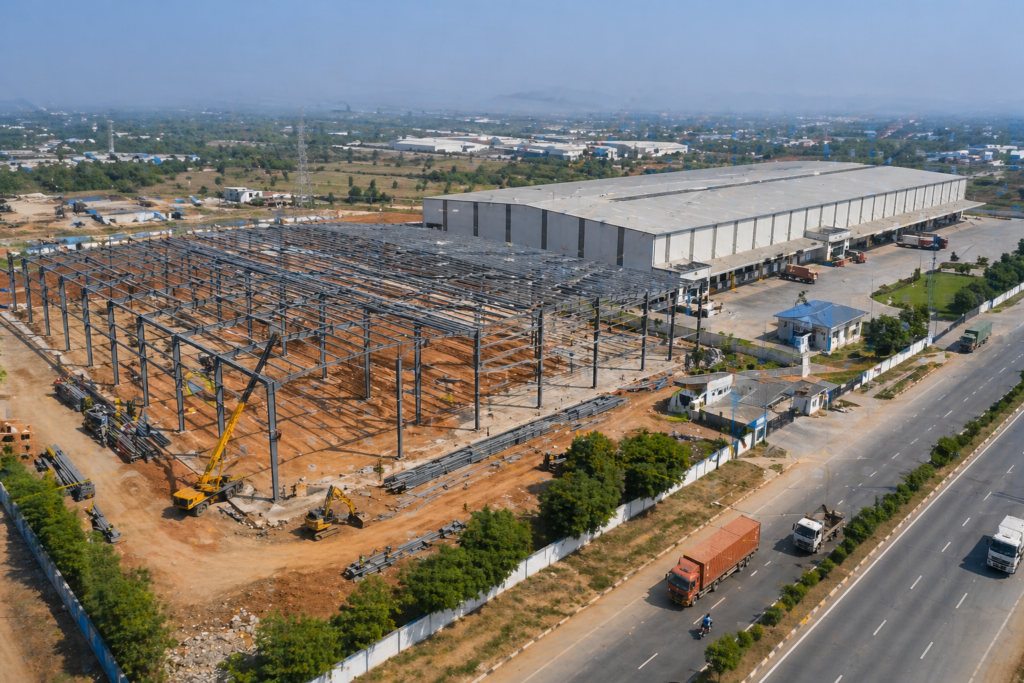
The logistics and warehousing industry is changing rapidly.
Businesses today are no longer looking for basic warehouse sheds that only provide storage space. Modern supply chains require infrastructure designed around operational efficiency, movement planning, scalability and future growth.
This is one of the main reasons why Build-to-Suit Warehouses are becoming increasingly popular across India and especially in emerging logistics hubs across South India.
Instead of adjusting operations to fit an existing warehouse, businesses now prefer warehouse infrastructure designed specifically for their operational requirements.
This shift is transforming how modern warehouse infrastructure is planned and developed.
What Are Build-to-Suit Warehouses?
Build-to-Suit Warehouses are warehouse facilities designed and developed based on the specific operational needs of a business.
Unlike traditional warehouses, where businesses must adapt to pre-built infrastructure, build-to-suit facilities are customized according to logistics movement, storage systems, loading requirements, truck access, workflow planning and future expansion needs.
This approach provides businesses with infrastructure designed for operational functionality rather than temporary storage convenience.
Why Businesses Are Moving Toward Build-to-Suit Warehouses
Modern logistics operations have become far more complex than traditional storage systems.
Businesses now manage:
- Faster inventory movement
- Large cargo volumes
- Time-sensitive dispatch operations
- Multi-location supply chains
- Scalable distribution networks
Because of this, generic warehouse infrastructure often creates operational limitations.
Build-to-Suit Warehouses help businesses overcome these challenges by creating infrastructure aligned with actual operational requirements.
Operational Efficiency Is Driving the Shift
One of the biggest advantages of Build-to-Suit Warehouses is improved operational efficiency.
Warehouses designed specifically for business operations support:
- Faster loading and unloading
- Better truck movement
- Organized inventory handling
- Improved dispatch flow
- Reduced operational congestion
A properly planned operational layout can significantly improve supply chain performance and reduce movement delays.
Businesses increasingly recognize that warehouse infrastructure directly impacts logistics efficiency.

Customization Improves Warehouse Performance
Every business operates differently.
For example:
- FMCG companies require fast-moving dispatch zones
- E-commerce businesses require sorting and packing areas
- Manufacturing support operations require crane provisions and industrial flooring
- Logistics companies require multiple loading bays and efficient truck access
Traditional warehouses may not support these requirements efficiently.
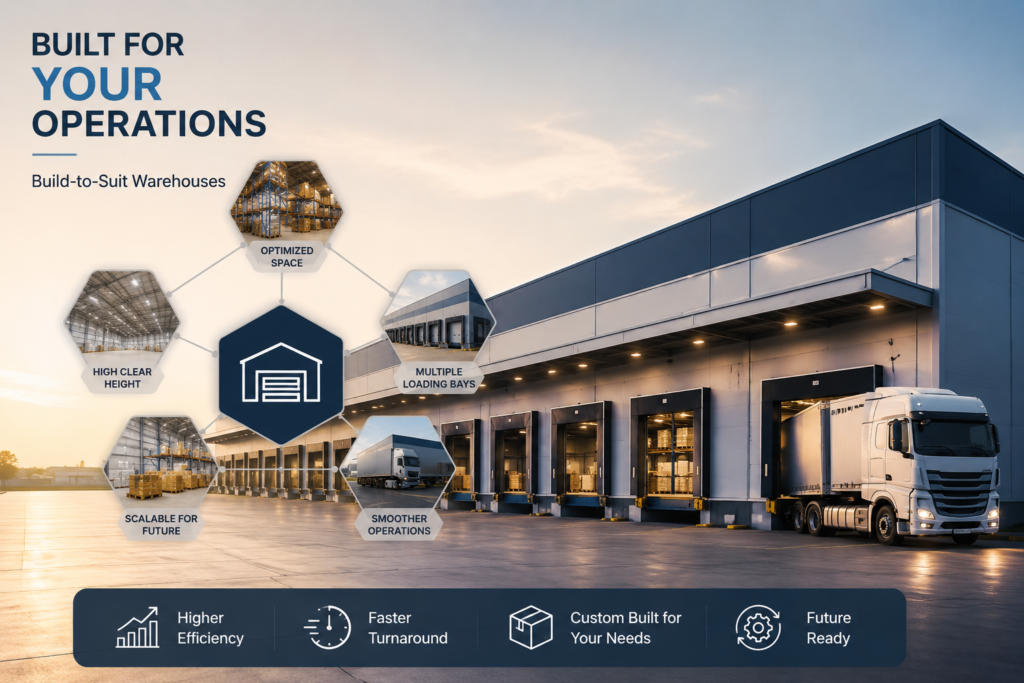
Build-to-Suit Warehouses allow businesses to customize:
- Loading bay configuration
- Internal operational layout
- Mezzanine planning
- Clear height requirements
- Storage systems
- Truck movement access
- Future expansion capability
This customization improves operational flow and long-term infrastructure efficiency.
High Clear Height Supports Better Storage Efficiency
Modern Build-to-Suit Warehouses often include higher clear height to improve vertical storage capability.
Warehouses with approximately 12-meter clear height support:
- Better racking systems
- Higher storage density
- Improved inventory segregation
- Efficient vertical storage planning
Vertical storage has become increasingly important because businesses want to maximize storage capacity without increasing warehouse footprint.
Higher clear height directly improves warehouse scalability and operational flexibility.
Multiple Loading Bays Improve Logistics Speed
Loading infrastructure is one of the most critical parts of modern logistics operations.
Build-to-Suit Warehouses are increasingly designed with multiple loading and unloading bays to improve movement efficiency.
This helps businesses reduce:
- Truck waiting time
- Dispatch delays
- Operational congestion
- Cargo handling inefficiencies
Dock levelers, organized loading zones, and proper movement planning improve truck turnaround and supply chain speed.
Efficient loading infrastructure is now considered essential for modern warehouse operations.
Scalability Has Become a Major Priority
Many businesses now plan warehouse infrastructure based on future expansion rather than only current requirements.
A warehouse that works today may become operationally restrictive within a few years.
This is why Build-to-Suit Warehouses focus heavily on scalability.
Scalable infrastructure allows businesses to:
- Increase operational capacity
- Expand storage systems
- Add loading infrastructure
- Improve operational flexibility
- Avoid future relocation costs
Long-term scalability has become one of the biggest advantages of customized warehouse development.
Strategic Connectivity Is Equally Important
Warehouse infrastructure alone is not enough.
Modern logistics operations also require strategic connectivity.
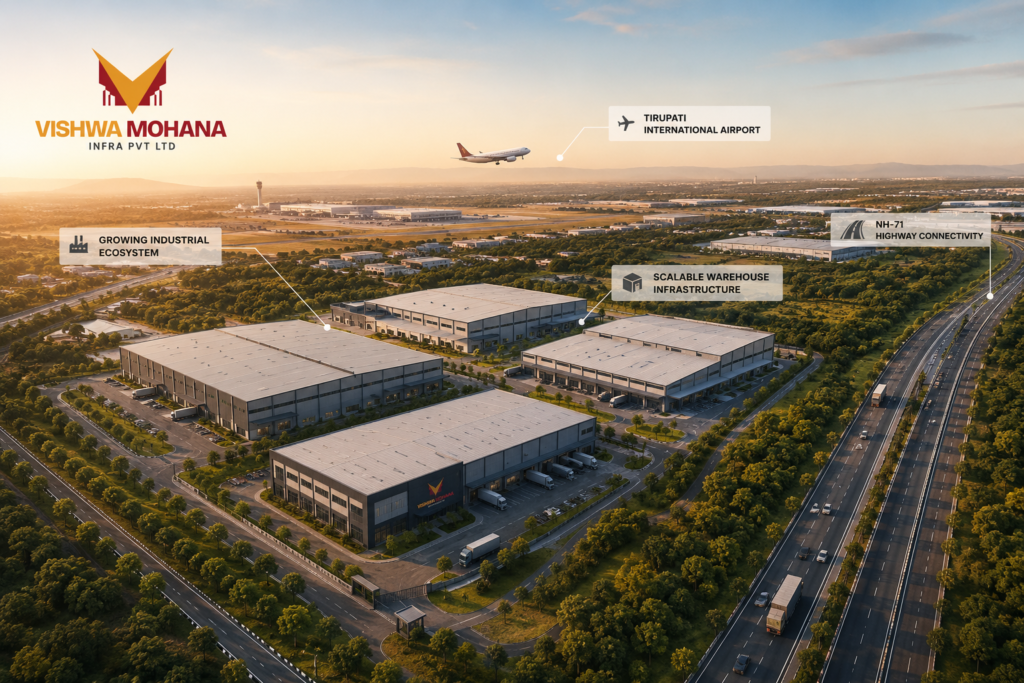
Businesses increasingly prefer locations offering:
- Highway access
- Airport proximity
- Industrial ecosystem support
- Efficient truck movement routes
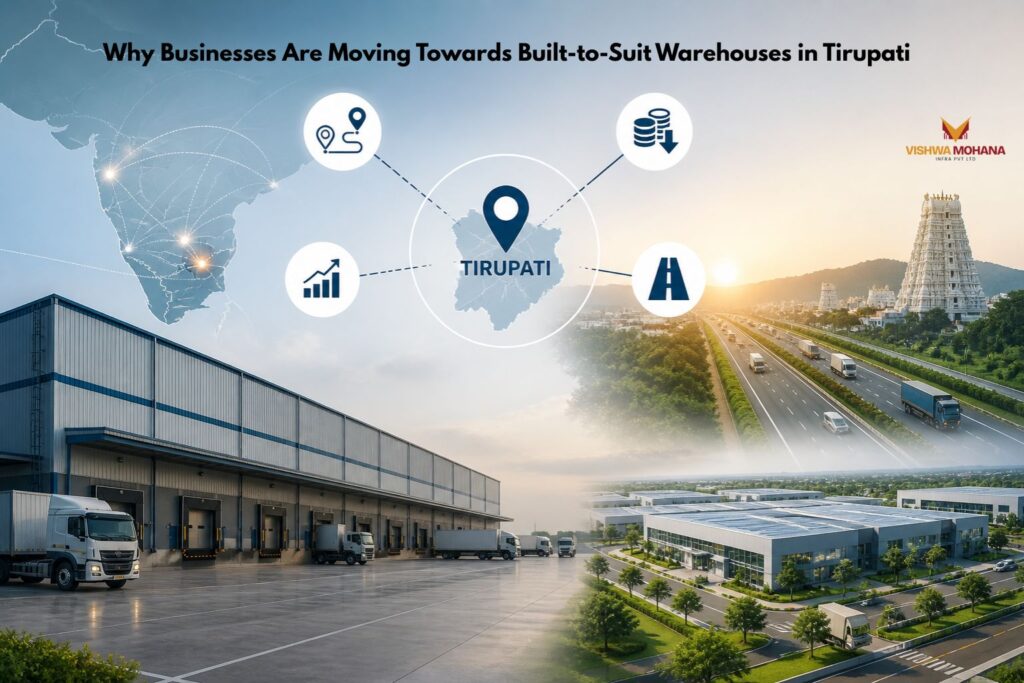
This is one reason why emerging logistics hubs like Tirupati are gaining significant attention.
Why Tirupati Is Emerging for Build-to-Suit Warehousing
Tirupati is gradually becoming an important logistics and industrial destination in South India.
Several factors are driving this growth:
- NH–71 highway connectivity
- Proximity to Tirupati International Airport
- Growing industrial ecosystem
- Strategic access to Chennai and Bangalore
- Lower operational costs compared to metro cities
As logistics demand increases, businesses are exploring build-to-suit warehouse opportunities in locations that offer both connectivity and scalability.
How Vishwamohana Infra Supports Build-to-Suit Warehousing
Vishwamohana Infra focuses on developing logistics-ready industrial infrastructure in Tirupati designed around modern operational requirements.
The planned development supports Build-to-Suit Warehouses with infrastructure including:
- 5 acres of planned logistics development
- 1,10,000+ sq.ft development across phases
- 12-meter clear height
- 10 loading and unloading bays
- Build-to-suit customization options
- Airport-adjacent connectivity
- Scalable operational planning
This type of infrastructure supports logistics companies, FMCG operations, industrial warehousing, manufacturing support and supply chain businesses.
Why Build-to-Suit Warehouses Represent the Future
Modern businesses no longer want infrastructure that simply stores inventory.
They need infrastructure that improves:
- Operational efficiency
- Movement speed
- Supply chain flexibility
- Inventory management
- Scalability
Build-to-Suit Warehouses provide businesses with infrastructure aligned directly with operational goals.
As logistics and industrial demand continue to evolve, customized infrastructure is becoming the preferred approach for long-term operational success.
Conclusion
Build-to-Suit Warehouses are rapidly becoming the future of logistics because businesses now prioritize operational efficiency over generic infrastructure.
Warehouses designed specifically for movement, scalability, loading efficiency and future expansion create significant long-term advantages.
As logistics networks continue expanding across South India, businesses increasingly require infrastructure that supports faster operations, efficient movement and scalable growth.
That is why build-to-suit warehouse development is becoming one of the most important trends in modern logistics infrastructure planning.
To more Know about warehouses please check previous blogs Vishwamohana infra
How much warehouse space does a growing logistics business actually need?
The required warehouse space depends on inventory volume, truck movement, loading operations and future expansion plans. Many growing businesses now prefer scalable warehouse infrastructure instead of fixed-size facilities to avoid relocation issues later.
Is it better to lease a ready warehouse or choose a Build-to-Suit warehouse?
Businesses with specialized operational requirements usually prefer Build-to-Suit warehouses because they can customize loading bays, clear height, storage layout, mezzanine structure and truck movement planning according to operational needs.
Why are companies moving warehouse operations to locations like Tirupati?
Locations like Tirupati offer lower operational costs, highway connectivity, airport access and better scalability opportunities compared to congested metro cities. This makes it suitable for logistics and industrial infrastructure development.
What are the biggest problems businesses face with standard warehouses?
Many standard warehouses create operational challenges such as:
Poor truck movement
Limited loading bays
Low clear height
Storage inefficiency
Lack of expansion flexibility
These issues directly impact supply chain performance and operational speed.
What makes a warehouse suitable for modern logistics operations?
Modern logistics operations require warehouses with:
High clear height
Efficient loading infrastructure
Wide internal roads
Dock levelers
Scalable planning
Highway and airport connectivity
The focus today is on movement efficiency rather than just storage capacity.
Why is warehouse scalability becoming important for businesses?
Businesses are growing faster than before, especially in logistics, FMCG and e-commerce sectors. Scalable infrastructure allows companies to expand operations without shifting locations or rebuilding warehouse systems.
How does warehouse infrastructure affect supply chain efficiency?
Warehouse infrastructure directly impacts:
Dispatch speed
Inventory movement
Truck turnaround time
Cargo handling efficiency
Operational productivity
Poorly planned infrastructure often increases logistics delays and operational costs.
Why are Build-to-Suit warehouses becoming popular in India?
Businesses increasingly prefer Build-to-Suit warehouses because customized infrastructure improves operational performance, storage efficiency and long-term scalability compared to generic warehouse sheds.