In todays fast-moving logistics industry, warehouse strategy plays a major role in controlling transportation cost, delivery speed and operational efficiency.
Centralized vs Decentralized Warehousing in South India so, many businesses focus heavily on transportation and distribution while overlooking one important factor:
Warehouse planning.
The way inventory is stored and distributed can directly impact supply chain performance and long-term business growth.
As logistics infrastructure continues to grow across South India, businesses are increasingly comparing two major models:
- Centralized Warehousing
- Decentralized Warehousing
Understanding the difference between these approaches helps businesses choose the right logistics strategy.
What is Centralized Warehousing in South India?
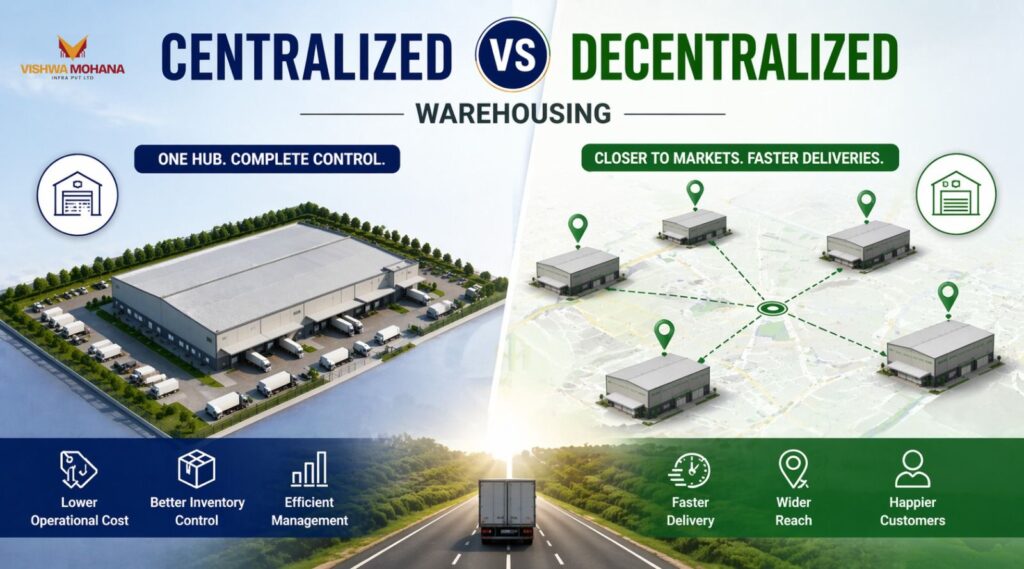
Centralized warehousing means storing inventory in one large warehouse facility and distributing products from a single operational hub.
This model is commonly used by businesses that want stronger inventory control and simplified operations.
Benefits of centralized warehousing:
- Better inventory management
- Lower operational overhead
- Easier monitoring and control
- Reduced duplication of stock
- Efficient bulk storage operations
Large warehouse facilities support centralized warehousing more effectively because operations can be managed from one location.
What is Decentralized Warehousing in South India?
Decentralized warehousing involves storing inventory across multiple smaller warehouses located near regional markets or customers.
This strategy focuses on faster delivery and improved regional accessibility.
Benefits of decentralized warehousing:
- Faster last-mile delivery
- Better customer reach
- Reduced delivery timelines
- Improved supply chain flexibility
- Better regional service coverage
This model is often preferred by businesses that prioritize delivery speed and customer experience.
Which Warehouse Model Reduces Logistics Cost?
There is no single answer because the right warehousing model depends on business operations and market requirements.
Businesses should evaluate:
- Delivery expectations
- Transportation costs
- Inventory movement
- Market coverage
- Operational efficiency
- Business expansion plans
Many businesses in South India now combine both strategies using a hybrid warehousing approach.
Why Hybrid Warehousing is Growing in South India
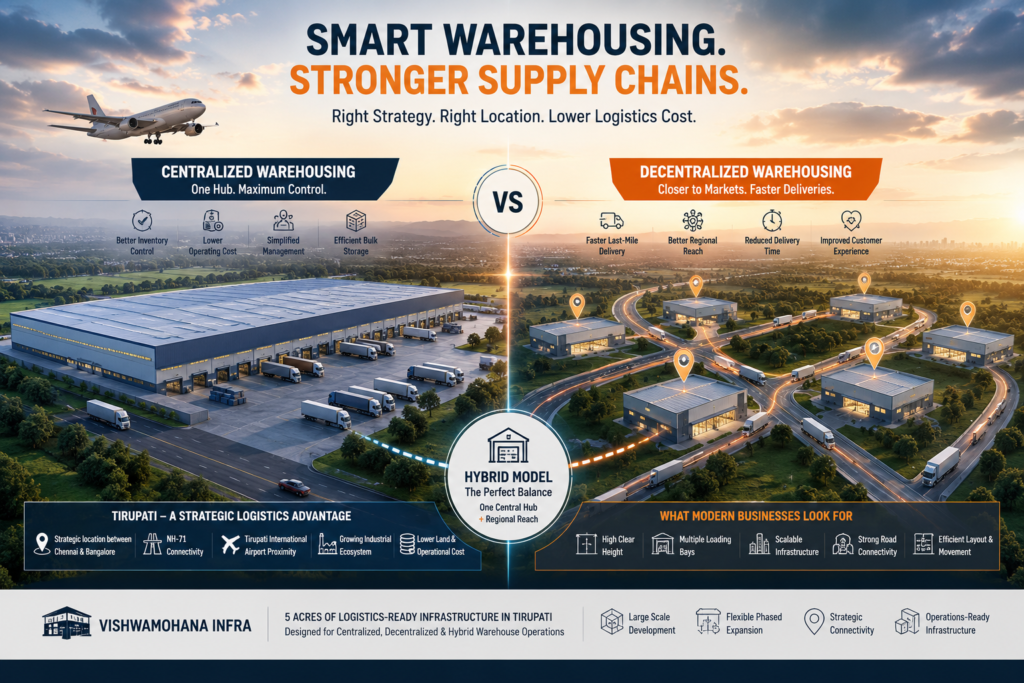
Hybrid warehousing combines:
- One centralized warehouse for bulk inventory storage
- Smaller regional distribution points for faster deliveries
This approach helps businesses balance:
- Cost efficiency
- Inventory control
- Faster distribution
- Scalability
As logistics demand increases, hybrid warehousing is becoming more common across South India.
Why Tirupati is Emerging as a Logistics Hub
Tirupati is rapidly developing into a logistics and industrial growth zone in South India.
Its strategic location offers strong connectivity advantages for warehouse operations.
Key advantages of Tirupati logistics infrastructure:
- Connectivity between Chennai and Bangalore
- Direct access to NH–71 highway
- Proximity to Tirupati International Airport
- Growing industrial ecosystem
- Lower operational costs compared to metro cities
These factors make Tirupati suitable for centralized, decentralized and hybrid warehousing operations.
What Modern Businesses Should Look for in a Warehouse
Choosing the right warehouse today requires more than simply evaluating space.
Modern businesses should focus on infrastructure efficiency.
Important warehouse features include:
- High clear height for vertical storage
- Multiple loading and unloading bays
- Strong truck movement access
- Scalable infrastructure
- Efficient operational layout
- Future expansion capability
Efficient warehouse infrastructure improves supply chain performance while reducing logistics cost.
How Vishwamohana Infra Supports Warehouse Development
Vishwamohana Infra focuses on logistics-ready industrial development in Tirupati designed for modern warehousing operations.
Key infrastructure advantages include:
- 5 acres of planned logistics development
- Strategic connectivity near NH–71
- Airport-adjacent location
- Flexible phased expansion
- Infrastructure for large-scale operations
- Support for build-to-suit warehouse development
The development supports centralized and decentralized warehousing strategies for businesses planning long-term growth.
Conclusion
Centralized vs decentralized warehousing in South India is not just a logistics decision.
It is a business strategy decision that affects:
- Transportation cost
- Delivery efficiency
- Inventory management
- Supply chain scalability
Businesses that choose the right warehouse strategy and the right location gain a significant operational advantage.
As logistics infrastructure continues to expand across South India, warehouse planning will play a critical role in business growth.
What is centralized warehousing?
Centralized warehousing refers to storing inventory in one large warehouse facility and distributing products from a central location.
What is decentralized warehousing?
Decentralized warehousing involves storing inventory across multiple smaller warehouses near regional markets or customers.
Which warehousing model is better for South India?
The ideal warehousing model depends on transportation cost, market reach, delivery expectations and operational goals.
Why is Tirupati becoming a logistics hub?
Tirupati offers strong highway connectivity, airport proximity, industrial growth and lower operational costs compared to major metro cities.
What industries benefit from warehousing in Tirupati?
Industries such as FMCG, e-commerce, logistics, manufacturing, electronics and distribution businesses benefit from warehouse infrastructure in Tirupati.